This guide provides an introduction to the structure and contents of the Handbook and its related materials. It explains how the different modules fit together and how to interpret and use the Handbook. In particular, it sets out:
- what the Handbook is;
- how to get started with reading the Handbook;
- how the Handbook’s modules are structured;
- what the different provision statuses mean; and
- further information about provisions.
What is the Handbook?
The Handbook sets out the FCA’s legislative and other provisions made under powers given to the FCA by the Financial Services and Markets Act 2000, as amended (FSMA). The Handbook is made up of instruments made by the FCA Board to implement these provisions.
Section 138G of FSMA requires the FCA to make rules made by the FCA Board publicly available, in writing, by a ‘rule-making instrument’. Most other legislative provisions made by the FCA (such as general guidance and codes) are also made by instrument. We publish our instruments online to fulfil this statutory requirement. The definitive version of the rules is the legal instrument and it is this text that should be used if there is any discrepancy between the instrument and the website page text.
Getting started
The Handbook is organised in a tree structure. When you navigate to the Handbook tree page, you’ll see that the Handbook is divided into various blocks. The Handbook also contains a Glossary of definitions, which specifies the legal meaning of various phrases and words used.
Each of the blocks in the Handbook comprises a number of modules (ie, sourcebooks, manuals and/or guides). Each sourcebook and manual has an abbreviation, which is how it is referred to across the Handbook. For example, the High Level Standards block contains the sourcebook Principles for Business, which is referred to as PRIN.
Each sourcebook and manual is subdivided into chapters. For example, the first chapter in PRIN is PRIN 1 (Introduction). Each chapter is then further subdivided into sections – for example, PRIN 1.1 (Application and purpose). Sections of the Handbook contain provisions, which each have a status that explains how it should be interpreted (jump to Status of provisions ).

From the Handbook tree page, you can navigate into sourcebooks, chapters and sections using the arrow buttons along the left. You can also choose to expand the whole Handbook to see all sections, or collapse the tree to see only the main blocks. If you click on a chapter or section, that page will open in a new tab.
Alongside the names of the blocks, sourcebooks, chapters and sections on the Handbook tree page, you’ll see 2 columns:
- Last modified – this shows you the date on which the block, sourcebook, chapter or section was last updated; and
- Recent changes (at chapter and section level) – this shows you the changes that were made to the chapter or section selected on the date shown in the ‘Last modified’ column. The changes are displayed in track changes, where red highlighting and strike-through formatting indicates deleted text and green highlighting and underlining indicates text that has been added.
For further information about viewing the changes that have been made to the Handbook over time, see Using the timeline.
To help you get started, the quick reference guide below shows you the content covered by each of the blocks and modules in the Handbook.
High Level Standards
The High Level Standards contain overarching requirements. They comprise:
- PRIN (Principles for Business) – fundamental obligations of all firms
- SYSC (Senior Management Arrangements, Systems and Controls) – regulatory management requirements
- COCON (Code of Conduct) – conduct of certain persons working in firms
- COND (Threshold Conditions) – minimum statutory criteria which a firm must satisfy to be given and retain authorisation
- APER (Statements of Principle and Code of Practice for Approved Persons) – standards of behaviour that we expect from approved persons
- FIT (the Fit and Proper test for Approved Persons) – minimum standards for becoming, and remaining, an approved person
- FINMAR (Financial Stability and Market Confidence) – guidance to our functions under the short-selling regulations
- TC (Training and Competence) – requirements for staff training and record keeping
- GEN (General Provisions) – guidance and rules on how to interpret the Handbook, disclosure and use of our logos
- FEES (Fees Manual) – provisions relating to the funding of the regulators, including the Financial Ombudsman Service and the Financial Services Compensation Scheme
Prudential Standards
The Prudential Standards provide prudential and specific notification requirements for the sectors listed for each sourcebook. They comprise:
- GENPRU (General Prudential sourcebook) – for most business sectors
- INSPRU (Prudential sourcebook for Insurers)
- MIFIDPRU (Prudential sourcebook for MiFID Investment Firms)
- MIPRU (Prudential sourcebook for Mortgage and Home Finance Firms, and Insurance Intermediaries)
- IPRUs – interim prudential sourcebooks which we aim to incorporate within the above modules in due course (the foundation of many of these provisions pre-date the Financial Services Authority):
- IPRU-FSOC (Interim Prudential sourcebook for Friendly Societies)
- IPRU-INS (Interim Prudential sourcebook for Insurers)
- IPRU-INV (Interim Prudential sourcebook for Investment Businesses)
Business Standards
The Business Standards are day-to-day conduct rules that apply to firms, as specified. They comprise:
- COBS (Conduct of Business sourcebook) – applies to all firms accepting deposits, conducting designated investment business and carrying on long-term insurance business in relation to life policies
- ICOBS (Insurance: Conduct of Business sourcebook) – applies to non-investment business of insurers
- MCOB (Mortgages and Home Finance: Conduct of Business sourcebook) – applies to firms conducting regulated mortgage activities and home finance
- BCOBS (Banking: Conduct of Business sourcebook) – applies to firms that accept deposits from banking customers
- CMCOB (Claims Management: Conduct of Business sourcebook) – sets out the detailed obligations that are specific to regulated claims management activities and activities connected to those activities carried on by firms
- FPCOB (Funeral Plan: Conduct of Business sourcebook) – sets out the detailed obligations that are specific to regulated funeral plan activities and the connected activities carried on by firms.
- PDCOB (Pensions Dashboards: Conduct of Business sourcebook) – sets out the detailed obligations for a firm carrying on regulated pensions dashboard activity and any related services permitted under the rules in this sourcebook.
- CASS (Client Assets sourcebook) – rules and guidance on holding client assets and client money, including requirements on segregation and safe custody of assets, statutory trusts for client money and retrieving information in the event of insolvency.
- MAR (Market Conduct sourcebook) – mainly applies to wholesale and professional markets.
- PROD (Product Intervention and Product Governance sourcebook) – sets out our product governance requirements for manufacturers and distributors and applies to MiFID investment firms, CRD credit institutions, MiFID optional exemption firms and branches of third country investment firms.
- ESG (Environmental, Social and Governance sourcebook) – sets out rules and guidance concerning a firm’s approach to environmental, social and governance matters.
Regulatory Processes
These modules describe the operation of our supervisory and disciplinary functions, as well as requirements on firms relating to the supervisory function. Regulatory Processes comprise:
- SUP (Supervision manual)
- DEPP (Decision Procedure and Penalties manual) – mainly about our decision-making procedures and the giving of statutory notices, penalties and investigations
Redress
- DISP (Dispute Resolution: Complaints sourcebook) – rules and guidance on how firms must handle and process complaints and report complaints to the FCA. This module also covers the operation of the Financial Ombudsman Service
- CONRED (Consumer Redress Schemes sourcebook) – details of redress schemes made under section 404 of FSMA where there has been widespread or regular failure by relevant firms to comply with requirements to a specific activity and consumers have suffered loss which a court would remedy, e.g. CF Arch cru Diversified Funds and Investment Funds
- COMP (Compensation sourcebook) – covers the Financial Services Compensation Scheme (FSCS)
Specialist sourcebooks
This part of the Handbook indicates to firms in certain sectors how the Handbook applies to their business (e.g., collective investment schemes). It comprises:
- ATCS (Access to Cash sourcebook)
- COLL (Collective Investment Schemes sourcebook)
- CREDS (Credit Unions sourcebook)
- CONC (Consumer Credit sourcebook)
- CTPS (Critical Third Parties sourcebook)
- FUND (Investment Funds sourcebook)
- PROF (Professional Firms sourcebook)
- RCB (Regulated Covered Bonds sourcebook)
- SECN (Securitisation sourcebook)
- REC (Recognised Investment Exchanges sourcebook)
- EMIRR (European Market Infrastructure Regulation Rules sourcebook)
Listing, Prospectus and Disclosure
Listing, Prospectus and Disclosure are requirements for issuers listed on, or seeking admission to, the Official List of the UK Listing Authority (UKLA), rules that apply to a sponsor and a person applying for approval as a sponsor, as well as prospectus and disclosure document requirements. They comprise:
- UKLR (UK Listing Rules sourcebook)
- PRR (Prospectus Regulation Rules sourcebook)
- DTR (Disclosure Guidance and Transparency Rules sourcebook)
- DISC (Product Disclosure sourcebook)
Handbook Guides
These are guides for the particular types of firm as indicated in the titles, pointing the firms in the direction of material in the Handbook that applies to them. They comprise:
- EMPS (Energy Markets Participants)
- OMPS (Oil Markets Participants)
- SERV (Service Companies)
- BENCH (General guidance on Benchmark Submission and Administration)
Regulatory/Registry Guides
These are guides to particular regulatory topics within the Handbook. They comprise:
- COLLG (Collective Investment Scheme Information Guide)
- ENFG (Enforcement Guide)
- FCG (Financial Crime Guide: A firm’s guide to countering financial crime risks)
- FCTR (Financial Crime Thematic Reviews)
- PERG (Perimeter Guidance manual)
- RFCCBS (Registration Function under the Co-operative and Community Benefit Societies Act 2014 Guide)
- RPPD (Responsibilities of Providers and Distributors for the Fair Treatment of Customers Guide)
- UNFCOG (Unfair Contract Terms Regulatory Guide)
- WDPG (Winding-down Planning Guide)
- M2G (MiFID 2 Onshoring Guide)
Content of Handbook modules
The general structure of the majority of modules is as follows:
- Application and purpose – who the module applies to and the motive of that module
- Main content – substantive provisions to implement the purpose outlined above. This may include relevant annexes and forms, where appropriate
- Transitional provisions (TPs) – this section will:
- set out the TPs for the module (if any)
- specify which parts of the module the TPs relate to and when those TPs commence
- detail the date that each TP comes into force and expires
- Schedules – split into the same structure throughout each module:
- Sch 1: Record-keeping requirements
- Sch 2: Notification and reporting requirements
- Sch 3: Fees and other required payments
- Sch 4: Powers exercised (now removed from most sourcebooks)
- Sch 5: Rights of action for damages under FSMA
- Sch 6: Rules that can be waived or modified
Status of provisions
Each provision in the Handbook has a status that explains how it should be interpreted.
Rules (R)
General rules, specialised rules and listing rules made under the Financial Services and Markets Act 2000 (FSMA). Most rules create binding obligations on firms. If a firm contravenes such rules, it may be subject to enforcement action and action for damages.
Evidential provisions (E)
Rules, but not binding in their own right, evidential provisions always relate to some other binding rule – they are only binding in relation to the rule to which they relate. Compliance with an evidential provision may be relied on (when it says so) as ‘tending to establish compliance’ with the rule to which it relates. Non-compliance with an evidential provision may be relied on (again, when it says so) as ‘tending to establish contravention’ of the rule to which it relates.
‘E’ is also used for paragraphs that make up the Code of Practice for Approved Persons (APER 3) to show whether or not the conduct of an approved person complies with the Statements of Principle for approved persons.
‘E’ is also used for certain paragraphs in the Code of Market Conduct which specifies:
- descriptions of behaviour that we consider amounts to market abuse and
- factors that we will take into account when determining whether or not behaviour amounts to market abuse.
Guidance (G)
Guidance in the Handbook is made under section 139A of FSMA and is mainly used to:
- explain the implications of other provisions
- indicate possible means of compliance, or
- recommend a particular course of action or arrangement.
Guidance is not binding and need not be followed to achieve compliance with the relevant rule or requirement. However, if a person acts in accordance with general guidance in circumstances contemplated by that guidance, we will treat that person as having complied with the rule or requirement to which that guidance relates.
‘G’ is also used for our statements on the procedure for giving statutory notices under FSMA, and policies on penalties and the conduct of interviews to which a direction has been, or may be, given under FSMA.
Directions (D)
Directions and requirements given under FSMA and relevant statutory instruments. These are binding upon the person or categories of person to whom they are addressed.
UK legislative material (UK)
Acts of Parliament, statutory instruments, regulations and orders. Changes made to UK text (such as the use of Handbook defined terms) are normally indicated by square brackets. A UK flag can also denote assimilated law.
Principles (P)
Statements of Principle for approved persons under FSMA which are binding.
Conduct (C)
Under FSMA, we specify descriptions of behaviour which do not amount to market abuse, which is specified within these provisions.
Notes
Notes provide informative, but non-legislative, material. Text is preceded by ‘Note:’ and contained in square brackets within the legislative material or as a distinct paragraph, or in some cases indicated by numbers in superscript which correspond to footnotes.
How to read provisions in the Handbook
When you click into a chapter or section in the Handbook, you’ll see a banner at the top of the page, which tells you the date of the version you’re viewing and when the chapter or section was last updated, as of that date. To find out more about viewing different versions of the Handbook, see Using the timeline.
From the banner, you can choose the types of provision you want to see, based on their status, by toggling the tick-boxes on or off. You can also choose whether you’d like to see deleted provisions. By default, all provision types are toggled on, and all deleted provisions are toggled off.
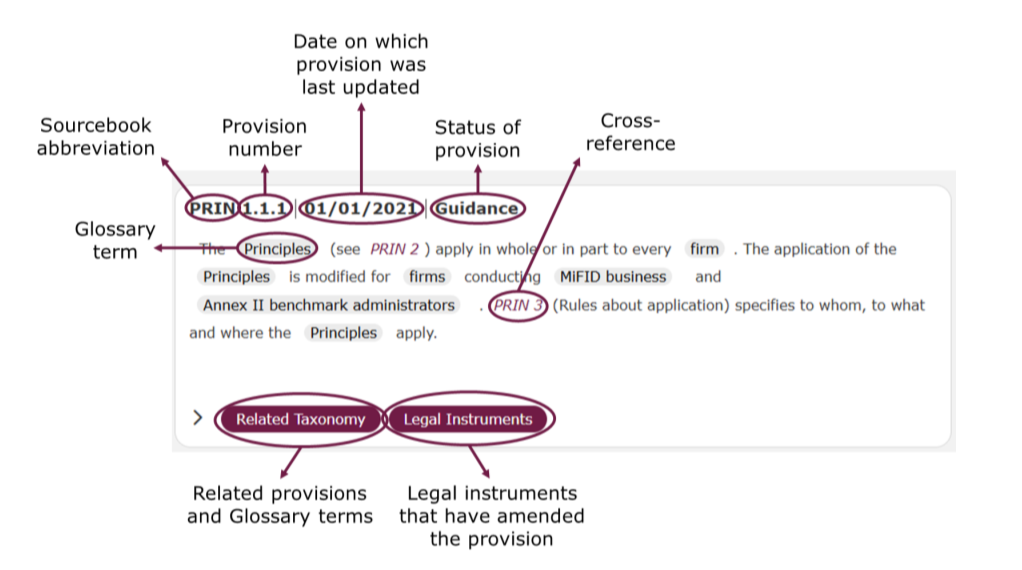
Above each provision, you’ll find the provision number, the date on which the provision was last updated and its status. Beneath each provision, you can click on the bubbles to find:
- related taxonomy – any provisions and glossary terms that relate to the provision in question, as well as any taxonomy tags we’ve created to group certain provisions together (for more information on the taxonomy, see How to search for content on the FCA Handbook website)
- legal instruments – all legal instruments that have amended the provision in question
- other documents – any related external information that relates to the provision in question, such as consultation papers, policy statements and Handbook Notices
Against rule provisions, you’ll also see a ‘Feedback on this rule’ option, which provides you with a link to the FCA Rule Feedback Tool.
Glossary terms are shown in italics and highlighted in grey. These terms have specific legal meanings, as defined in the Glossary of definitions. You can click on Glossary terms within provisions to bring up a pop-up box with the term’s definition. You can click through to see the definitions of other Glossary terms used in that definition, expand the definition or open it in a new tab.
Cross-references to other provisions in the Handbook are shown in italics as well, and are coloured maroon. When you click on a cross-reference, the relevant part of the Handbook will open in a new tab.